Water Damage Restoration Tucker GA: The Complete Guide 2026
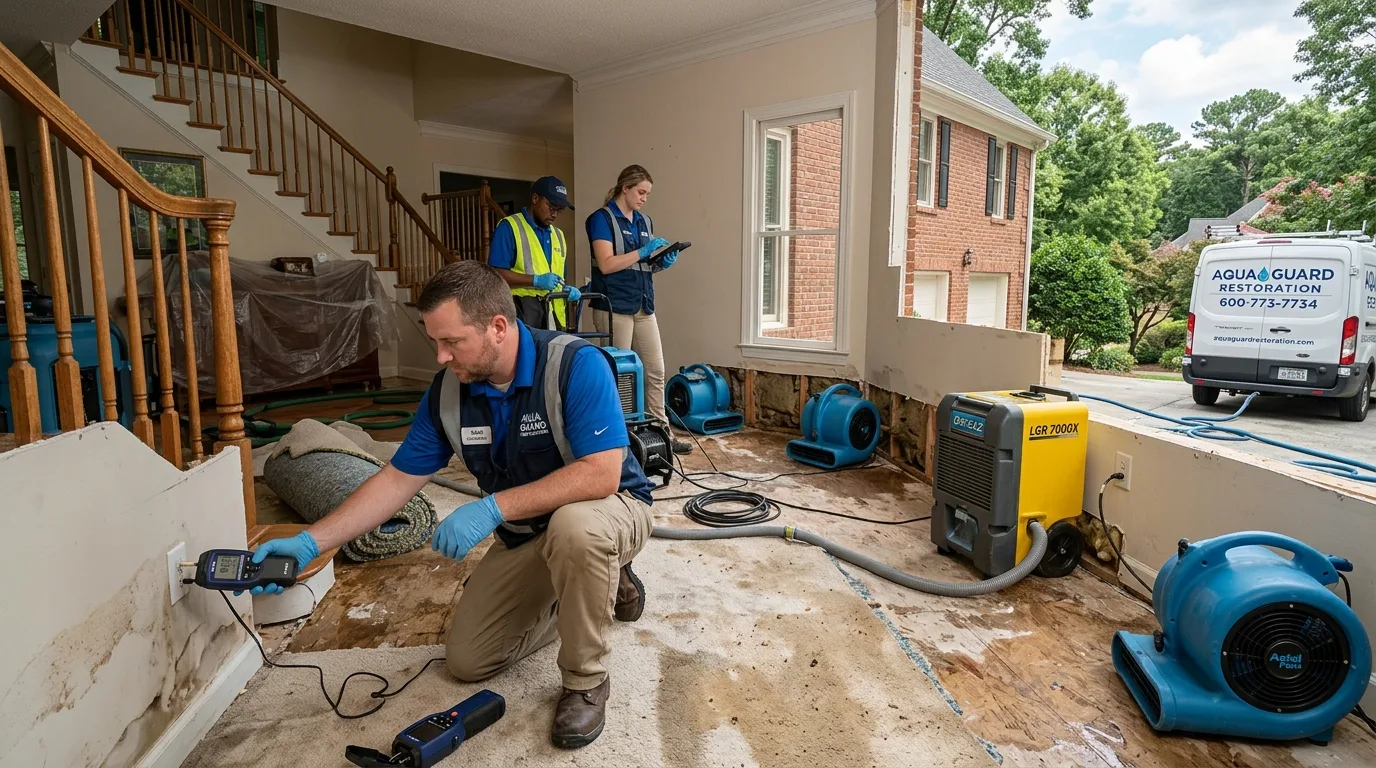
Every year, Tucker homeowners face water damage from burst pipes, flash flooding, appliance failures, and storm intrusion — and most have no idea what to do in the first critical hours. Water damage restoration in Tucker, GA follows a specific process, and understanding that process helps you protect your property and navigate the insurance claim successfully. In this post, we cover the causes of water damage in Tucker, the step-by-step restoration process, cost factors, insurance guidance, and how to choose an IICRC-certified contractor.
Water Damage in Your Tucker Home Right Now?
Call (888) 376-0955 for 24/7 emergency water extraction and structural drying throughout Tucker and DeKalb County.
Why Water Damage Restoration Matters in Tucker, GA
Tucker’s humid subtropical climate creates water damage risk that runs year-round. Spring storms from March through May deliver heavy rainfall onto already-saturated ground, causing flash flooding that enters basements and crawl spaces faster than drainage systems can handle. By summer, thunderstorm season continues the pattern — and Tucker’s documented 50% above-average tornado risk means storm-related structural damage is a real threat, not a statistical abstraction. Tucker homeowners near Henderson Park know well that a single severe storm can send water through foundation cracks within hours.
The 24-to-48-hour mold growth window is the factor that makes water damage restoration in Tucker genuinely urgent. Tucker’s ambient humidity sustains rapid mold colonization on wet drywall, wood framing, and insulation. Within two days of an unmitigated water event, a restoration job can become a remediation job — and the cost difference is significant. Calling a certified restoration team within the first hour, not the first day, is the decision that most often separates a manageable claim from a large one.
Types of Water Damage Events in Tucker
Clean water (Category 1): Supply line breaks, overflowing sinks, or appliance supply failures produce clean water that poses the lowest health risk and the lowest remediation cost ($3–$4.25/sq ft locally). The water heater that leaks overnight, the dishwasher line that separates behind the cabinet — these are common Tucker scenarios.
Gray water (Category 2): Toilet overflow from the bowl (not the trap), dishwasher water, and some appliance drainage qualify as gray water. Costs run $4–$6.50/sq ft for mitigation. Contaminants require more thorough decontamination than Category 1, but the hazard level is manageable with proper PPE and antimicrobial treatment.
Black water (Category 3): Sewage backup, floodwater from outside (which carries ground contamination), and any water that has sat long enough to allow bacterial growth are Category 3. This is the most expensive category to remediate ($7–$12/sq ft) because all porous materials that contacted the water must be removed and disposed of as biohazardous waste. Tucker homes in areas prone to municipal sewer overflow during heavy rain events — particularly older neighborhoods — should maintain sewage backup insurance riders for this reason.
The Water Damage Restoration Process
Step 1 — Emergency contact and dispatch: A certified firm should be available 24/7 and respond within 60 minutes to Tucker and DeKalb County properties. The sooner extraction begins, the lower the total damage.
Step 2 — Moisture inspection and documentation: Thermal imaging cameras and calibrated moisture meters map all affected areas — including hidden saturation inside walls and under flooring that isn’t visible to the naked eye. This documentation is essential for insurance claims.
Step 3 — Water extraction: Truck-mounted or portable extraction units remove standing and absorbed water. For Tucker basement flooding events, high-volume truck-mounted units can remove thousands of gallons per hour.
Step 4 — Structural drying: Commercial air movers and industrial dehumidifiers are positioned per psychrometric calculations to achieve target moisture levels throughout affected materials. Daily moisture readings are logged until all structural materials reach certified-dry status.
Step 5 — Antimicrobial treatment: EPA-registered antimicrobials are applied to prevent mold colonization during the drying window — essential in Tucker’s humid climate where the mold threat is constant.
Step 6 — Material removal: Wet drywall, carpet, pad, insulation, and flooring that cannot be dried in place are demolished and removed. This step is often counterintuitive to homeowners but is necessary — wet materials that remain in place become long-term mold sources.
Step 7 — Reconstruction: Once structures are certified dry, reconstruction restores the property to pre-loss condition. DeKalb County permits are required for trade work under the 2024 ICC codes adopted January 1, 2026.
IICRC-Certified Water Damage Restoration in Tucker
Tucker Water Damage Restoration follows every step above — call (888) 376-0955 for a free assessment.
Water Damage Restoration Costs in Tucker, GA
Water damage restoration in Tucker costs between $1,384 and $6,384 for most residential projects, with a 2026 national average of $3,867. Local mitigation pricing runs $3–$7.50 per square foot depending on water category. Reconstruction and rebuild work adds $20–$37/sq ft.
The single biggest variable in Tucker water damage cost is how quickly extraction begins. A Category 1 water event that is extracted within 2 hours costs dramatically less to restore than the same event discovered 24 hours later — because the drying window determines how much material must be removed and replaced. The difference can be thousands of dollars.
For a detailed cost breakdown, read our guide on water damage restoration costs in Tucker, GA.
Insurance Claims for Tucker Water Damage
Most Tucker homeowners with standard property insurance have coverage for sudden and accidental water damage — burst pipes, appliance failures, and roof leaks during storms. Flooding from rising groundwater or surface water requires separate flood insurance (NFIP or private). Sewage backup coverage requires a specific rider on most policies.
Documentation is the key to claim success. A certified restoration firm provides moisture maps, thermal imaging reports, daily drying logs, and itemized scope of work — the documentation an adjuster needs to approve the full claim. For detailed guidance, read our post on filing an insurance claim for water damage in DeKalb County.
How to Choose a Water Damage Contractor in Tucker
Look for three things: IICRC certification (specifically WRT and ASD credentials), direct insurance billing capability, and documented experience with Tucker and DeKalb County properties. Ask to see moisture documentation from recent completed jobs — a professional firm maintains drying logs, not just before-and-after photos.
Verify that any contractor you consider is familiar with DeKalb County permit requirements for reconstruction work. Contractors who skip permits create code compliance problems that can affect your insurance coverage and property resale. For more vetting guidance, see our post on why IICRC-certified water damage restoration matters in Tucker.
Frequently Asked Questions
How fast does water damage spread in Tucker homes?
Water spreads faster in Tucker’s humid climate than in drier regions because ambient moisture in the air reduces the evaporation rate from wet materials, allowing saturation to deepen. Within 1 hour, water penetrates drywall and begins soaking into wall cavities. Within 24 hours, mold can begin to colonize. Within 48 hours in Tucker’s summer climate, active mold growth is visible on wet cellulose materials. This timeline makes the first hour after discovering water damage the most important.
Can I do water damage cleanup myself in Tucker?
Minor surface water on non-porous floors can be mopped up by homeowners. However, any water that has saturated drywall, subfloor, insulation, or framing requires professional assessment and drying equipment that consumer fans and dehumidifiers cannot provide. Using inadequate equipment creates the illusion of dryness while leaving moisture trapped in structural materials — which produces active mold growth within days. In Tucker’s climate, DIY cleanup of anything beyond truly surface water creates more risk than it saves in cost.
What is the first thing I should do after water damage in Tucker?
Stop the source if possible (shut off water at the main valve or appliance shutoff), then call a certified restoration firm immediately. Do not wait to assess the full scope of damage — the extraction timeline is more important than a thorough self-assessment. Move valuable items out of affected areas if it is safe to do so without walking through standing water. Do not use household fans to dry the space — this can spread mold spores if any have already begun to colonize.
Start Your Tucker Water Damage Recovery Now
Call Tucker Water Damage Restoration at (888) 376-0955 — 24/7 emergency response for all of Tucker and DeKalb County.
Related: