Tucker's Red Clay Soil and Basement Water Intrusion in Tucker, GA
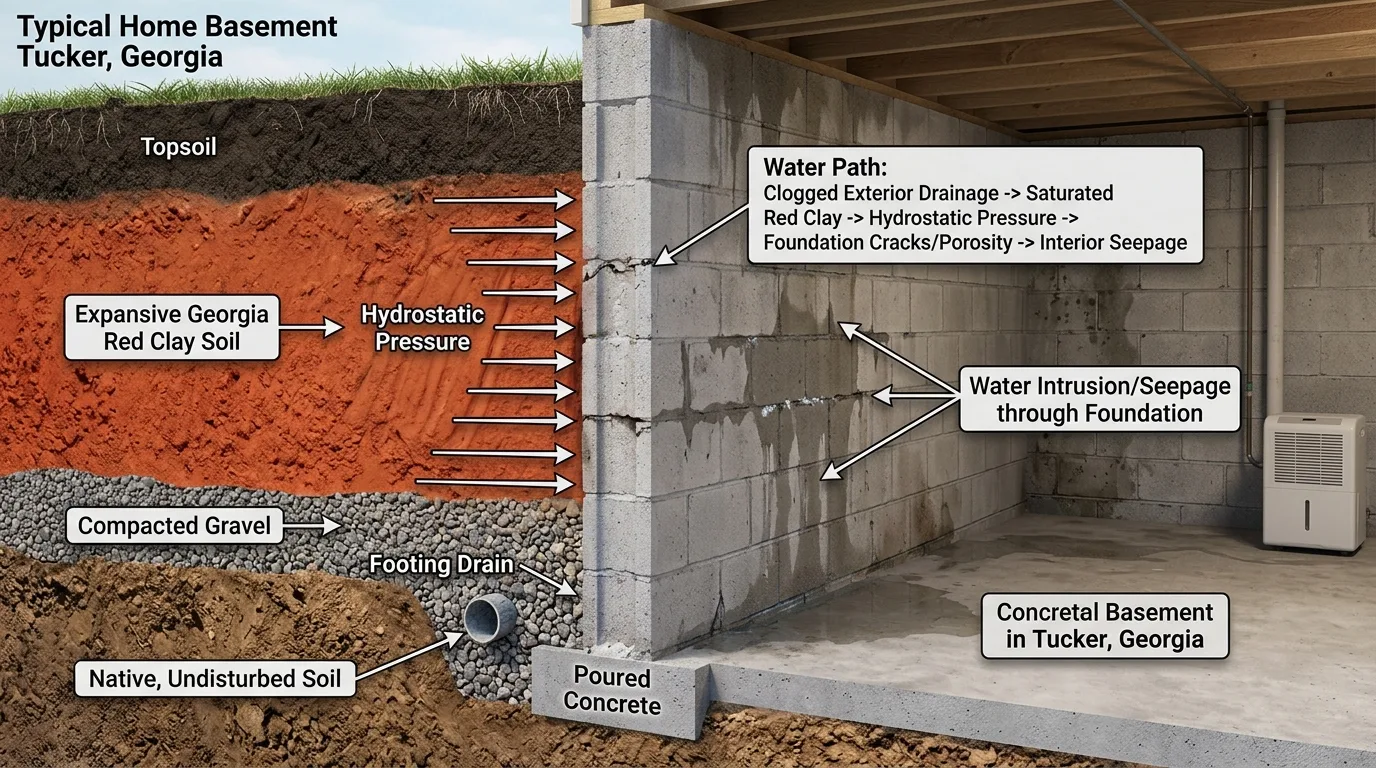
If your Tucker, GA basement floods every spring — or shows water stains around the base of the walls even when it hasn’t rained — Georgia’s red clay soil is almost certainly the root cause. Understanding how clay soil behaves around foundations explains why so many Tucker homeowners deal with recurring basement water intrusion, why standard gutters-and-grading fixes often don’t work, and what permanent solutions actually look like. In this post, we cover the soil science, the structural consequences for Tucker homes, cost factors for permanent solutions, and the seasonal timing that matters most in DeKalb County.
Recurring Basement Flooding in Tucker?
Call (888) 376-0955 for a free inspection. We identify the source and recommend the right permanent solution for Tucker's clay soil conditions.
Why Georgia Red Clay Soil Causes Basement Water Intrusion
Georgia’s predominant red clay soil has physical properties that create water intrusion pressure through mechanisms that are fundamentally different from sandy or loam soils. Understanding those properties is the starting point for solving the problem.
Low permeability: Clay particles are extremely fine and compact tightly, creating soil with very low permeability. Water moves through clay slowly — 10 to 100 times slower than through sandy soil. When Tucker receives its typical 50+ inches of annual rainfall, water builds up in clay soil rather than draining away quickly. This pooling generates hydrostatic pressure against any underground structure it contacts — specifically, basement walls and slab foundations.
Expansion and contraction: Red clay soil is highly expansive. When it absorbs water, it swells significantly — up to 30% by volume in extreme cases. This swelling generates direct mechanical pressure against foundation walls in addition to hydrostatic water pressure. Then, when dry conditions return — typically Tucker’s late summer and fall — the same clay shrinks and pulls away from the foundation, creating gaps and hairline fractures in concrete and block walls. Each saturation-desiccation cycle widens these pathways. Over 20 to 40 years, this cycle is responsible for the progressively worsening basement water intrusion that homeowners in the Smoke Rise subdivision and throughout older Idlewood Acres report.
Get a Free Basement Inspection in Tucker
We assess your specific clay soil drainage situation and recommend the right waterproofing system — no pressure, no upsell. Call (888) 376-0955.
How Tucker’s Climate Amplifies the Problem
Tucker’s climate delivers the wet-dry cycles that drive clay soil expansion and contraction in a consistent annual pattern. Spring (March through May) brings heavy rainfall onto ground that is already near field capacity from winter precipitation — this is when hydrostatic pressure peaks for DeKalb County homes. The soil is saturated, expanded, and pressing against foundations simultaneously.
By late summer, Tucker’s clay soil begins to dry as evapotranspiration exceeds rainfall input. The shrinkage gap between foundation and soil creates a new pathway for the next saturation event — water runs directly down the face of the foundation rather than being intercepted by soil first. Homeowners who notice that basement water intrusion seems to get worse every few years are often observing the cumulative effect of these cycles widening existing foundation cracks.
Types of Basement Water Intrusion From Clay Soil
Through-wall seepage: Water percolates through the foundation wall itself. Block foundations are especially vulnerable because mortar joints allow water passage even when blocks are intact. Concrete foundations develop microcracking from clay pressure that expands gradually.
Floor-slab intrusion: In Tucker homes with basements, hydrostatic pressure from the soil beneath the floor slab can push water up through floor cracks and wall-floor joints. This presents as wetness appearing at the base of walls and spreading inward from the perimeter.
Window well flooding: Above-grade foundation windows with inadequate window wells and drains collect water that seeps directly into basement window frames.
Crawl space moisture: Homes with crawl spaces throughout Tucker’s Henderson Mill area experience moisture rising through unprepared crawl space floors — the clay soil below the crawl space releases moisture vapor that saturates wood framing and floor joists from underneath.
Permanent Solutions for Clay Soil Basement Water Intrusion in Tucker
Interior French drainage system: A perimeter channel drain installed along the interior footing captures water entering through wall and floor joints and routes it to a sump pump basin for exterior discharge. This is the most common and cost-effective permanent solution for Tucker homes because it manages water that has already penetrated — which is the reality for most established foundations. Installation typically costs $4,000–$8,000 for a standard Tucker basement in DeKalb County.
Sump pump with battery backup: The active component of interior drainage — a submersible pump that automatically removes collected water. Battery backup systems ensure operation during Tucker storm events that cut power while simultaneously delivering heavy rain. Sump pump installation adds $500–$1,500 to drainage system cost.
Exterior waterproofing: Excavation around the full foundation perimeter to apply waterproofing membrane directly to the exterior foundation surface. More expensive ($8,000–$15,000+) and more disruptive than interior drainage, but addresses the water source before it enters the wall rather than after. Best for new construction or foundations with severe structural deterioration.
Crawl space encapsulation: A heavy-duty vapor barrier across crawl space floors and walls, sealed at penetrations, combined with a crawl space dehumidifier. Standard installation in Tucker’s DeKalb County market runs $3,000–$8,000 depending on crawl space size.
Cost Factors for Waterproofing Tucker Homes
Interior drainage system costs in Tucker run $3,000–$8,000 for standard residential basements, with the primary variables being basement perimeter length and whether existing concrete must be saw-cut for channel installation. Homes in Tucker’s Henderson Mill area with longer basement perimeters will pay at the higher end of this range. DeKalb County permits are required for drainage work — factor permit costs into project budgets.
Temporary fixes — hydraulic cement crack injection, interior wall sealers — cost less ($500–$1,500) but address symptoms rather than the underlying pressure problem. They often fail within 1 to 3 seasons of Tucker’s wet-dry cycles because the expanding clay soil generates more pressure than the patch can withstand. The total cost of repeated temporary fixes over 5 to 10 years typically exceeds the one-time cost of a permanent drainage system.
Frequently Asked Questions
Does gutter cleaning solve basement water intrusion in Tucker?
Gutter cleaning and grading improvements reduce the volume of surface water directed toward the foundation — and they are worth doing. But they do not address hydrostatic pressure from clay soil saturation, which is the primary driver of basement flooding for most Tucker homes. Gutters that are clean and properly extending water 6 feet from the foundation can reduce intrusion events, but they rarely eliminate them in high-clay-content soil areas like Tucker’s DeKalb County neighborhoods.
Will hydraulic cement fix my Tucker basement permanently?
Hydraulic cement stops active water flow temporarily and can be a useful emergency measure. However, the clay soil pressure that caused the crack continues to act on the foundation wall after the patch is applied. Most Tucker homeowners find that hydraulic cement patches in clay-heavy soil crack or fail within one to three years as the expansion-contraction cycle acts on the patched area. Permanent solutions require redirecting water before or after it enters, not plugging individual entry points.
How do I know if my Tucker home needs interior or exterior waterproofing?
Interior drainage is appropriate for most Tucker homes with active basement water intrusion — it is more cost-effective, less disruptive, and handles the fundamental problem (water has already penetrated the wall). Exterior waterproofing is most appropriate for new construction, foundations with severe structural cracking, or situations where the exterior membrane has completely deteriorated. A professional inspection identifies which approach makes economic sense for your specific foundation condition.
Permanent Waterproofing Solutions for Tucker Homes
Tucker Water Damage Restoration provides free inspections and honest recommendations for clay soil basement problems throughout DeKalb County. Call (888) 376-0955.
Related: